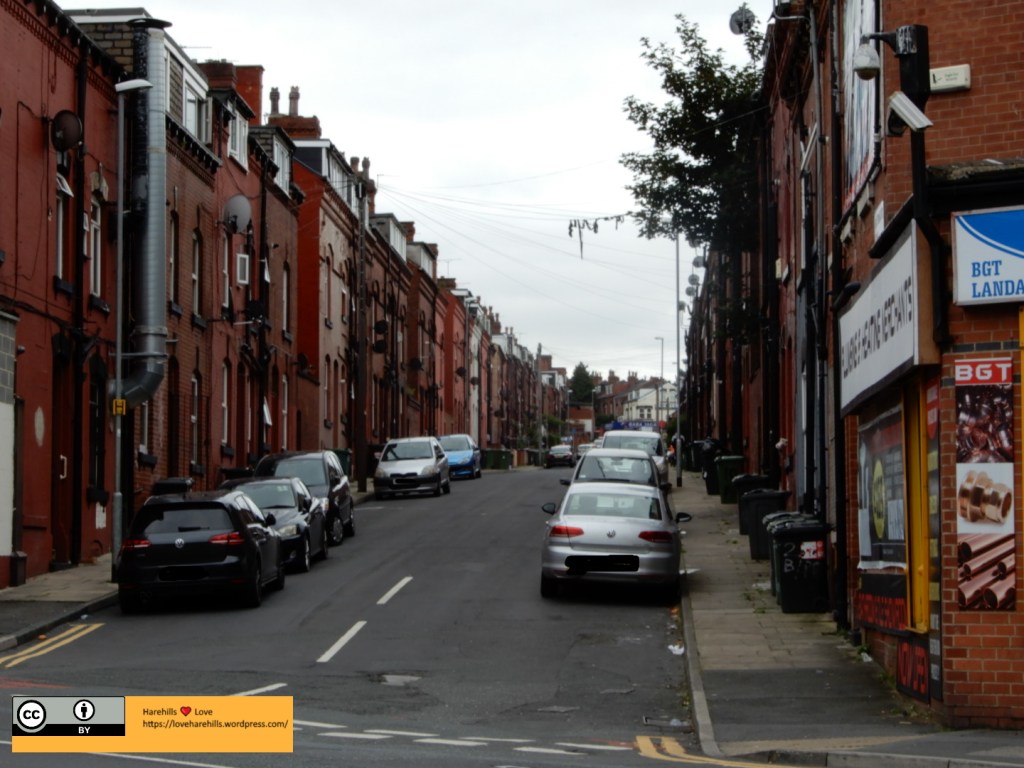
I put out a request for article ideas, and Kenny Koala happily obliged:
I want to do lots of articles on the history of the area, as I’ve learned some amazing stuff in my time here. However, back-to-backs are incredibly fascinating, and are definitely one of the defining features of Harehills, and so that is where we shall start.
What are Back-to-Backs?
At it’s most basic, they’re terraced housing, but each side of the terrace is the front of a house, and they share one back wall.
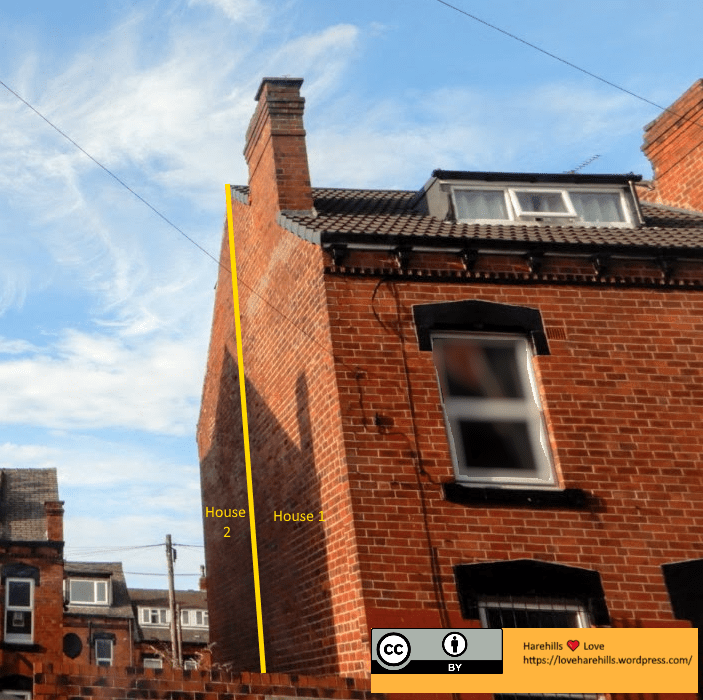
If you’re from certain areas of Leeds, Birmingham and a few places in between, the concept of a back-to-back may feel pretty normal, like it’s just another building type. I learnt recently this isn’t the case in many areas of the country, with the concept seeming quite alien to some people.
Back-to-Backs aren’t just one set design though, there are a number of variations, which can be seen across Harehills and Chapeltown.
A blog, https://backtobackhouses.wordpress.com/, details the different types, with photos as examples in their article “A short history of back-to-backs houses in Leeds from 1890 -1937“, which is a fantastic read, and if I recreated that, it would just be plagiarism, so I please do, check out the article if you’d like to know more about the types of Back-to-Back houses in the area.
Suffice to say, at its most simple, back-to-backs were a way to achieve high density, affordable, urban houses, and the ones still around to this day continue to serve that purpose.
How Did Back-to-Backs Come About?
A lot of people know Harehills for it’s prodigious use of back-to-back housing, from the end of the 19th and into the early 20th centuries. However, back-to-backs, have been around since the late 18th century.
Essentially, in many areas they were seeing as quick and cheap way to cram as many workers as possible into an area. As a result of such low planned, high density living, many of the areas rapidly fell into disrepair, grime and ultimately were labelled as slums.
Here in Leeds, we start to see them come about in Briggate in the 1790’s, which were built and kept in the worst possible way. Santitation was earth toilets, right beneath bedrooms quite often, water was from standpipes, there was no damp proofing, and they would have been pretty awful to live in in both winters and summers. However, the thrifty landlords were taking advantage of Leeds is perpetual population booms as more and more work moved into cities. In an acre, you could fit anywhere between sixty and seventy-five properties, and cram in three-hundred people.
Just as long as you didn’t care about their welfare on any level.
They were dirty and disgusting places, breeding grounds for disease and sickness. Squalor. Squalor is the right word. There aren’t many prisons in the world today that could rival these back-to-backs for depravity and inhumanity. If you found yourself living in one of these places, you had no choice. The city couldn’t grow fast enough for the growing population, and developers and landlords knew it, and they took advantage.
These early back-to-backs, were built around courtyards, with the back-to-back properties spread around it a u-shape. You might imagine a courtyard to be a nice place, people pay fortunes for flats with access to courtyards after all. However, they were just mud, not the paving slabs or cobble stones you might be thinking of. But you could grow stuff right? Well no, on most sides of the courtyard you have these extremely tall buildings, blocking out the light.
It genuinely sounds like some of the worst living situations you can imagine. It would have been noisy, it would have smelt, you would have been ill a lot, and if you weren’t ill your neighbour might be, and then you’d end up ill anyway.
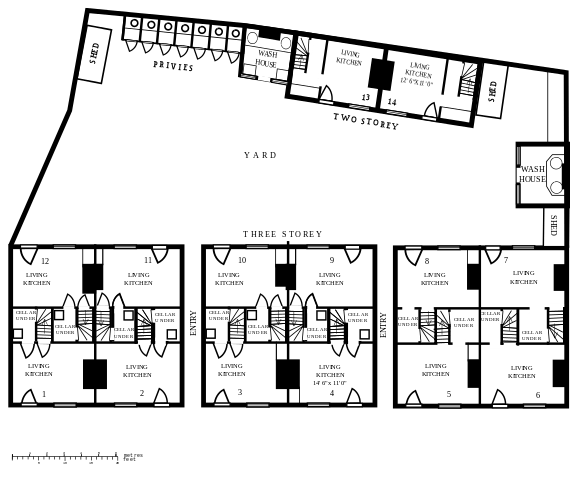
I know, a diagram of a floor plan doesn’t make it clear really, so how about a picture from Birmingham.
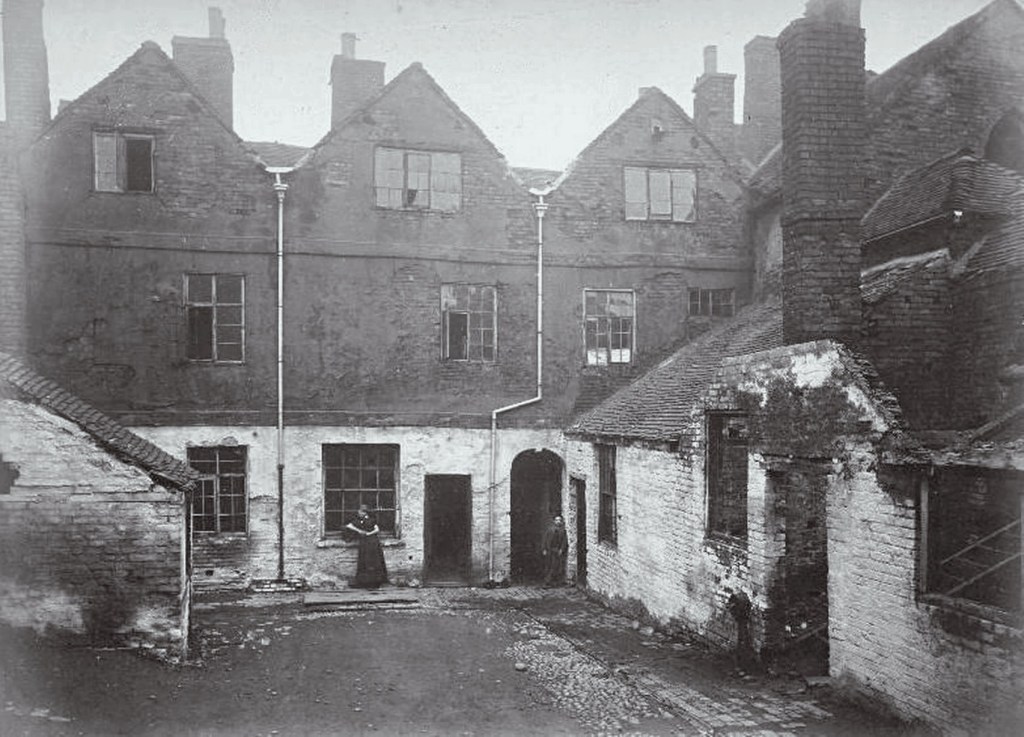
These weren’t evil people, they weren’t convicted robbers and murderers. These were the hardworking people that powered the Georgian and Victorian eras.
The idea of back-to-backs, by the time we get to the Victorian era had become controversial. There was a growing awareness of what hell holes these places were. In the 19th century there was an ongoing battle to try and ban back-to-backs, with reformers recognising the slums for what they were, but supporters would try and rehabilitate the concept. It’s notable that in the mid to late nineteenth century we see the courtyard design give way to the streets of back-to-backs we know in Harehills and Chapeltown today.
There were many improvements on the concept, they were more spacious could support multigenerational families, improved sanitation, built from better materials, they were generally safer.
What we commonly call bin areas now, weren’t for bins. They were for waste however, human waste. These were the areas for communal toilets. There could be no more than eight back-to-backs in a row, on one side of the street, without there being a toilet area. This was a major improvement over what came before, but you still had no privacy, it was still going to smell. The houses though were plumbed in for water though, no more standing pumps.
The writing was on the wall though, despite the improvements. The Victorians felt they knew what back-to-backs meant, and so they were made illegal.
Construction in some places stopped immediately, and rapidly these structures were vanishing. Not in Leeds though. See, contrary to the general view of back-to-backs, they were actually popular in Leeds. They were being built by the council, they had the improvements, and they were affordable.
So Leeds resisted the efforts to ban their building, and so they continued to be built. Local acts were passed in 1863 to ensure the improvements were embedded into new builds.
In 1909 the UK parliament passed a decisive act covering town planning, the Housing, Town Planning, &c. Act 1909. It codified town planning, made it so local authorities had to ensure homes were built to certain legal standards. Section 43 of the act also banned back-to-back houses.
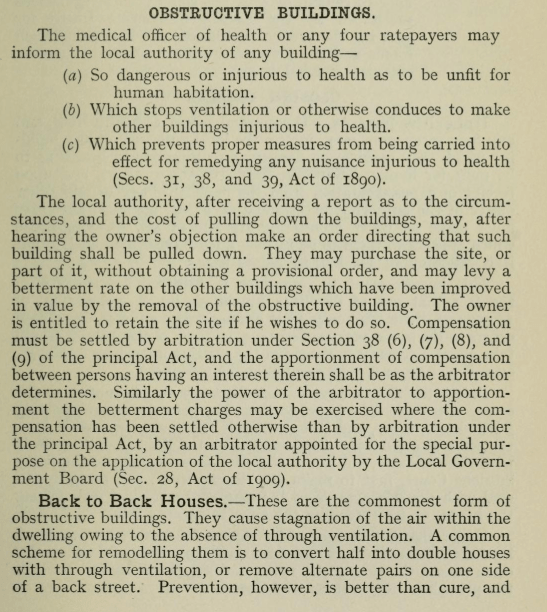
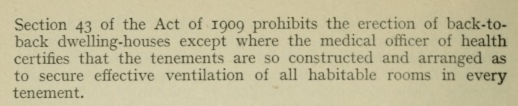
by
Thompson, W; Great Britain Housing and Planning Act 1909
However, Leeds, still in love with the back-to-back houses, utilised a loophole that allowed for already authorised buildings prior to May 1909 to continue, which meant the last back-to-back development was only completed in 1937.
Why let the government spoil the party?
What Happened to Back-to-Backs Since Then?
First thing first, Leeds still has back-to-back houses. Lots of them. Around 19,000 of them. Because late nineteenth and early twentieth century served a niche in Leeds.
However, many of the worst were knocked down, whole streets, and estates of them. At their peak, there were about 78,000 back-to-back in Leeds, about 72% of all houses were back-to-backs.
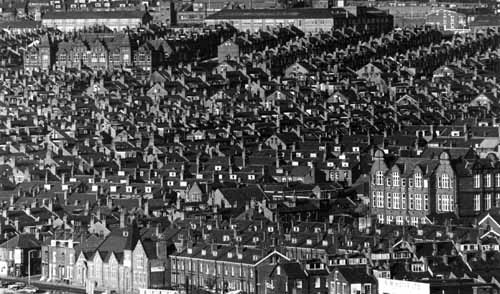
The tearing down and replacing of back-to-backs, or the conversion was over many decades. It was only in the late 70’s, that Banstead Grove and Harehills Terrace, a dilapidated collection of back-to-backs were torn down, and ultimately replaced with Banstead Park in the early 80’s.
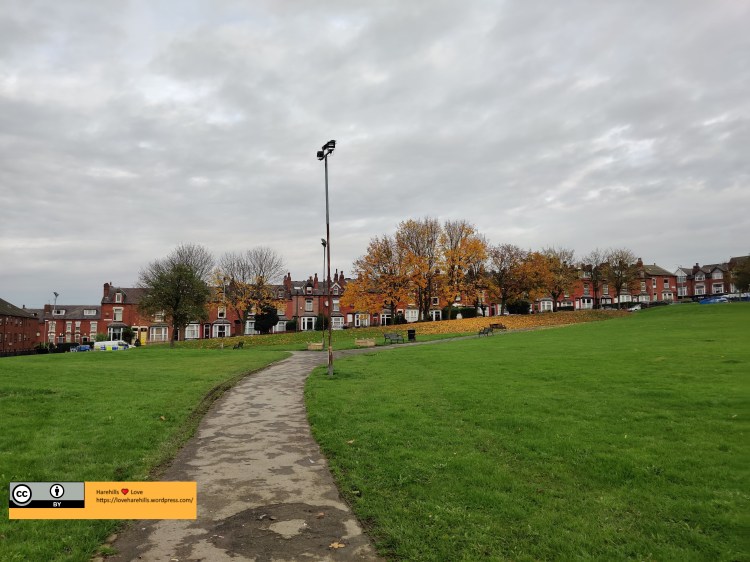
This isn’t how it played out across the country. Most cities got rid the their stock entirely during the intervening decades. In the post World War II era, when Britain was rebuilding, they were also clearing away the terrible, and disgusting history of back-to-backs. In 1959, MP William Wheeldon said:
Its chief defect, in addition to its lack of size, its dampness and its dilapidation, is that it is not self-contained. There is no water supply inside the house, no adequate provision for discharging slop water, and the only sanitary convenience is often some distance from the house and usually common to two or more houses. This convenience is frequently in a revolting condition because of its common user. There is no bath or means of taking a bath in many of the houses. The whole outlook from these houses is sullied by soot besmirched in a soot-laden atmosphere. Many of those houses, I am sorry to say, are in my constituency. They are houses from which men went out more than forty years ago to fight in the 1914–1918 war. They were told that they were to have homes for heroes, yet the sons of those men went out from the same houses in 1939 to fight for their country, and many of those houses are still standing today.
Labour and Co-operative MP, representing Birmgham Small Heath, William Wheeldon, in the House of Commons, 30th November 1959
Birmingham was so successful in eradicating the slum like back-to-backs, that today the last surviving court style back-to-back is a museum, allowing people to see the squalor and depravity we made people living in. Back-to-backs of various types are also part of museums in Liverpool and Bradford, where they are used to give snapshots of life in these dwellings at different periods of history.
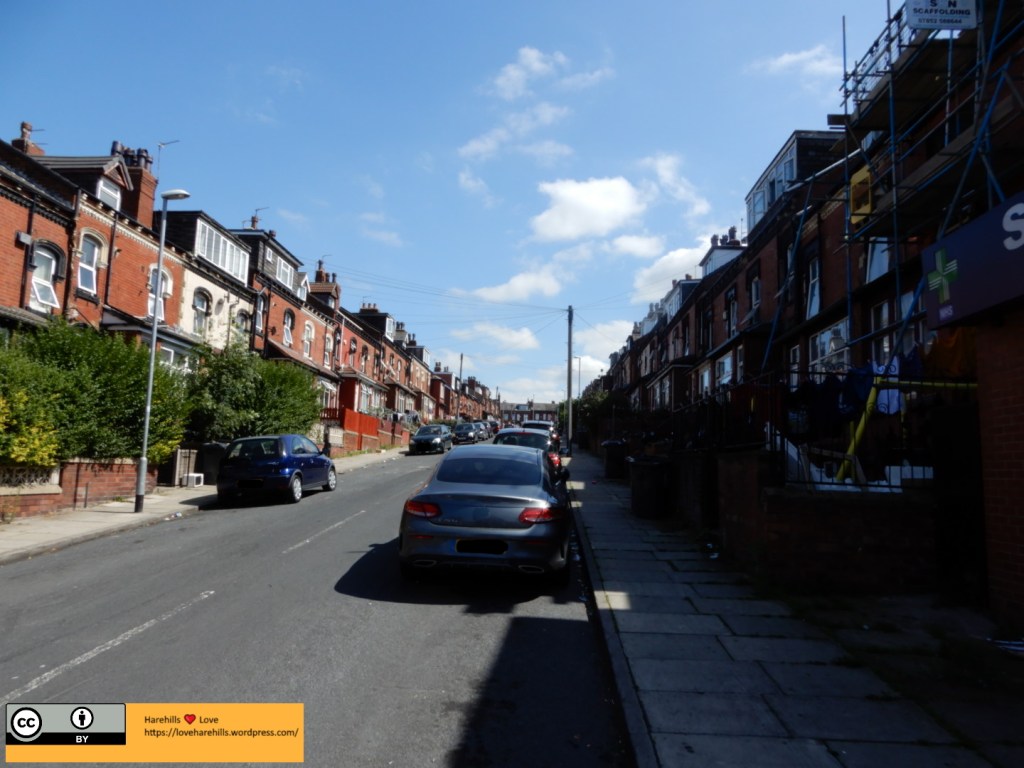
Not all were torn down entirely, in some places every other house might have been removed, with back features added to the remaining houses, or in some cases the houses on either side of the terrace might be converted into one house. Apparently, this would allow air to flow through the property, which at the time was one of the criticisms of back-to-backs, (it was a different time for medicine)
Which brings us to where we are today, a few thousand spread across Leeds and still very much in use, and a few examples left in other places.
The majority of which appear to owned by private landlords renting to the public, though some are still owned by the council. This came about following the Right to Buy system in the 1980’s by the Thatcher government, and did a lot to change the face of Harehills and Chapeltown, but also potentially halted plans for the replacement of back-to-backs since the council no longer owned them, vastly increasing the cost to any project to remove and replace them. That’s a story for another time however.
The need for high density housing never went away, our cities have continued to grow in population that far outstrips its growth in size. If back-to-backs weren’t the national answer, what was? High rises, blocks of flats. Many of which became slum-like in their own ways, and have since been torn down. Others are still being built, they’re getting taller and more complicated. These days it’s the only way to build near town centres.
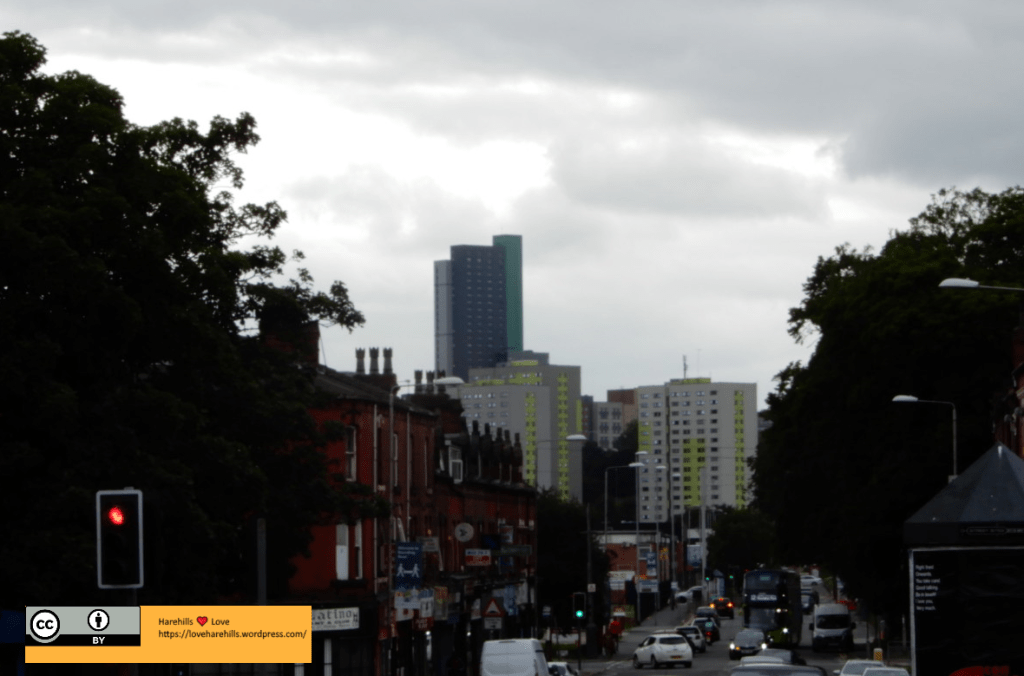
Few are what you would call attractive, they are after all giant concrete blocks and are still wear the poorest in society end up living. Though these days, in some blocks its where the richest go instead, with apartments fetching hundreds of thousands on the markets.
Fortunately, many councils have put a lot of work in to try and fix many of the problems of high rises. Some have been torn down to be replaced.
Unfortunately, some attempts to improve them, have also resulted in great tragedies, such as what happen at Greenfell tower in 2017, where there was a massive loss of life, due to attempts budget cutting cladding on the outside of the building. An event for which justice is still being sought.
The point is, high rise flats replaced back-to-backs, in many good and bad ways. To this day, we are trying to deal with and improve on that legacy.
We lack the powerful reformers that the later back-to-backs a much better place to live, but there are people out there today working hard, standing against greedy developers and landlords to, make them safe, and make them good places to live.
What It Like to Live in One Today?
For much of this article, I am reliant on research, on standing on the shoulders of people are more intelligent and articulate than I. This subject though, I do have some expertise in.
I live in one of Harehills back-to-backs. I like it, for the most part. I’m a tall guy, and I love the tall room design, from the tall windows you get some great views high up.
That said, there is still a lack of privacy. While these houses now do have bathrooms, with working toilets, and working baths, because the houses all face each other, a lot of things you don’t want to see, can be seen. Because they’re so close together, sounds carry.
That said, I live facing what we call bin areas, which breaks up my view a bit, but having researched this article, I can only imagine what the tenants a hundred years ago saw from the same spot. A dozen people queuing up to use the toilet, lovely. So the privacy has at least improved.
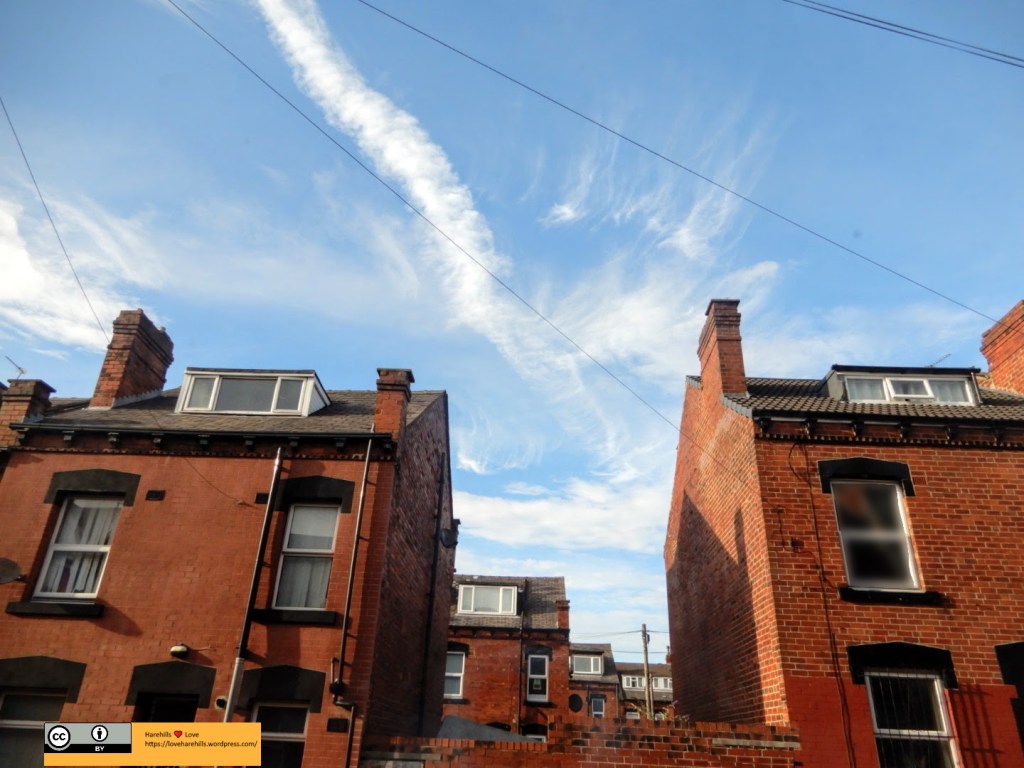
They’re pretty warm in winter, and bearable in the summer.
The street is downhill in a North-Westerly direction, so get some great sights around sunset, and a decent view of the sun rising early in the morning in the other direction. Aside from that, for most of the day, my side of the street is out of the sun. That does mean that snow lasts a bit longer on this side, and it also means that plants need that bit more TLC to grow.
The kitchens are small, which can be a problem if your making big meals. That’s not a big issue though.
I actually do love living in my back-to-back, and would likely move to another. I might, however, aim for one with a bit of a yard, so I can really exercise my green thumbs. At the moment, I rely on a trough, and some hanging baskets. I did see some images of my house from 12 or more years ago, and whoever lived here then, shared my aspirations for a bit of greenery on these rows of houses, and had done so in a far more eye catching way.
Your experience living in a back-to-back today, may heavily depend on your neighbours, it will also heavily depend on your landlord. I am lucky to have a good landlord and letting agency, others might not, and have a very different experience to me.
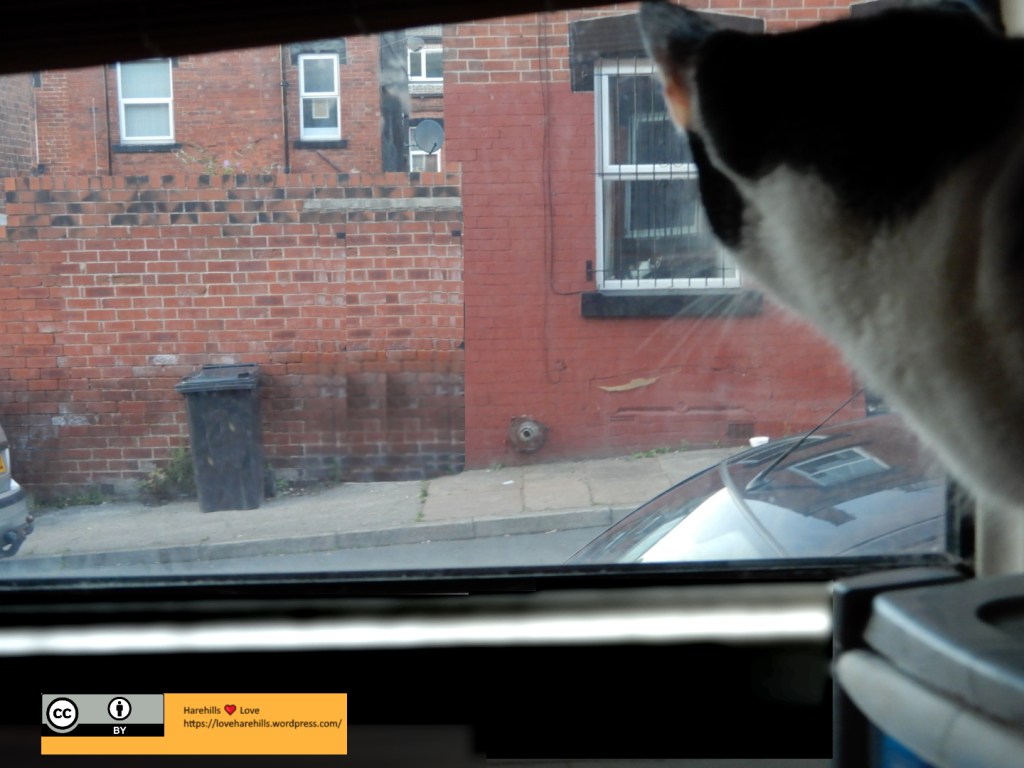
What About the Future of Back-to-Backs?
Here in parts Harehills and Chapeltown, back-to-backs are still with us, and I don’t see that changing. They still fill that niche. The replacing of back-to-backs with anything but flats will reduce the number of homes in the area.
Back-to-backs are dated structures though. Most no longer reach the basic requirements for fire safety, and are in need of being updated.
In 2004, Parliament passed the Housing Act, now this produced some fundamental, and since abandoned changes to how houses were built and sold, (anyone remember Home Information Packs?). It also brought in new or changed laws relating to housing conditions, in regards to health and safety.
Part 1: Housing conditions
20.Part 1 of the Act replaces the existing housing fitness standard contained in the Housing Act 1985 with the Housing Health and Safety Rating System. It also adapts and extends the powers of enforcement currently available to LHAs to tackle poor housing conditions.
21.These changes are intended to help LHAs to prioritise their intervention based on the severity of the health and safety hazards in the home.
22.The new framework is largely through free-standing provisions, although some of the provisions of the 1985 Act will remain in that Act with appropriate amendments.
Notes on Housing Act 2004, from https://www.legislation.gov.uk/ukpga/2004/34/notes/contents
In regards to back-to-backs, the provisions in law for improving the the health and safety, weren’t really enforced for a long time. Urgent cases were dealt with, as problem landlords surfaced that weren’t in anyway taking care of their properties.
Since Greenfell however, fire safety in high density, low cost housing is now a far more significant concern for local housing authorities, and there are indications that this includes back-to-back housing.
The Fire Safety Principles for Residential Accommodation, by Leeds City Council’s Housing Regulation Team covers in detail what needs to be done for back-to-back housing in sections 2.5 (starting at page 14), and also 2.6 in relation to basements of these properties. You can read the full things here, (and you should): https://www.leeds.gov.uk/docs/Fire%20safety%20principles%20for%20residential%20accommodation.pdf
2.5 Back-To-Back Houses (Single and Multiply Occupied Households)
The Fire Safety Principles for Residential Accommodation, by Leeds City Council’s Housing Regulation Team, November 2019
These are houses that back directly onto another at the party wall and have other properties at either side. This results in there being only one route of escape out of the property. In a high number of cases this route passes
through a risk room, thus creating a situation where all bedrooms in the property become inner rooms. In larger double fronted back-to-back properties, the route of escape can come down the middle of the property to
the final exit door. Where this situation arises the fire design principles for this type of back-to- back can follow the schemes detailed for the appropriate property type, for example a 2 or 3 storey building, and the mode of occupation (i.e. single household, flats, Category A HMO or Category B HMO).
Section 2.5.1 then goes on to detail all the requirements to achieve the regulations. It’s a lot of work, but its’ what it will take to ensure back-to-backs are brought up to date for safety, and its the responsibilities of owners to ensure that their properties meet these standards.
How widespread the enforcement is over 19,000 properties, nor whether the 1,558 Leeds City Council owned back-to-back in Leeds have all been upgraded. However, the document I cited above is from November 2019, and it will take time for the regulations to be implemented across the whole housing stock.
These changes will ensure the future of our back-to-backs though, which are unique, useful and historic.
I haven’t found a campaign online, but I have had heard tell that there have been calls for the Leeds back-to-back houses to be listed. Whether this would help or hinder efforts to keep them safe and modernise them is probably doubtful, but they are a significant part of Leeds history during industrialisation and continue to be part of the story of the city today.
That’s worth remembering.
Where To learn More
This is a long and fascinating subject, I may have only scratched the surface of a lot of it. There are fantastic resources out there if you want to learn more about the history of back-to-backs in Leeds and nationally.
I genuinely believe this to be a fascinating subject, so I hope you will read more, these are articles and sites I’ve relied upon to learn about back-to-back houses, but there is more out there:
https://backtobackhouses.wordpress.com/2017/02/07/a-short-history-of-back-to-backs-houses-in-leeds-from-1890-1937/ – an interesting blog, but this article in position does a great job of explaining how Leeds current crop of back-to-backs came about, and the variations in their designs
https://archive.org/stream/housingtownplann00bent/housingtownplann00bent_djvu.txt – the full text of the Housing, Town Planning, &c. Act 1909, or the more convenient notes on the same act https://archive.org/details/handbooktohousin00thom/mode/2up by Thompson W. (that’s the version I relied on)
https://www.tandfonline.com/doi/full/10.1080/03090728.2017.1398902?scroll=top&needAccess=true& – Joanne Harrison’s amazing paper on “The Origin, Development and Decline of Back-to-Back Houses in Leeds, 1787–1937” which was incredibly informative, and the page has the built in ability to read text out loud – a handy feature more sites should have
https://www.legislation.gov.uk/ukpga/2004/34/contents – this is official online version of the 2004 Housing Act, it’s long and complicated, but you can skip to the notes which are an easier read
https://en.wikipedia.org/wiki/Back-to-back_house – Wikipedia’s entry on back-to-back houses covers a lot of the basics, and delves nicely into history, and contemporary issues as a good jumping off point
Thank you
Thank you for taking the time to read this article, feel free to leave feedback, if you have stories about living in or near back-to-backs we’d love to hear them.
At some point in the future there will be a follow up article that will delve into more specifics about the housing make up in Harehills, but I would like to roll into that follow up real people’s experiences across the years with this form of housing.
Lastly, but far from least, I’d like to acknowledge @KennyKoalaBear for their suggestion and the links they offered up to get me started, and @Harehills111 for offering up more resources and a sounding board for this article.


 Harehills ❤️ Love
Leave a reply to jllegend Cancel reply