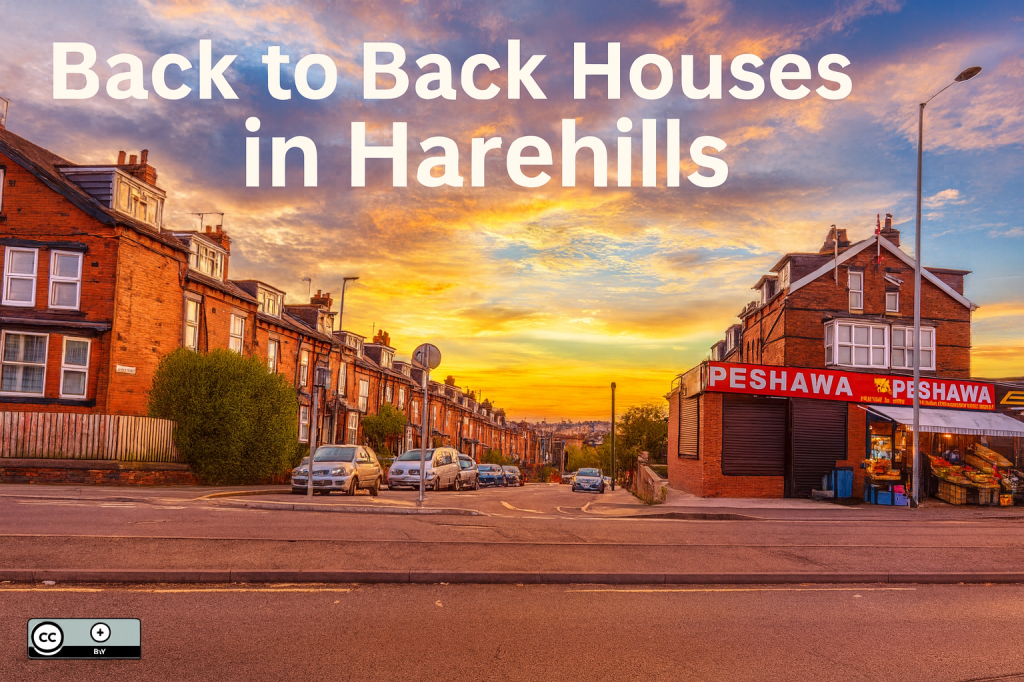
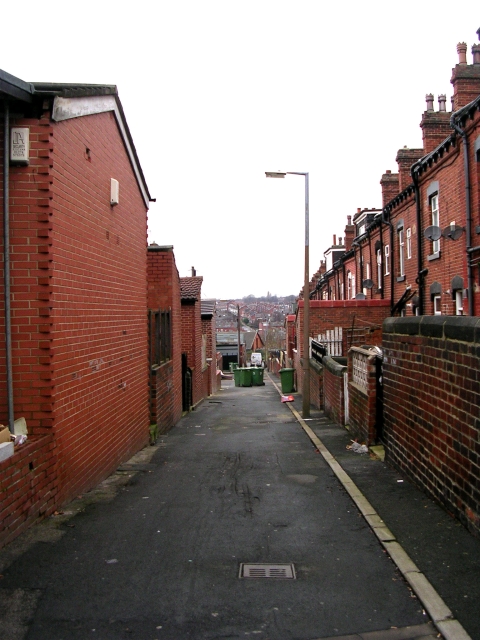
If you walk through the streets of Harehills today, you are walking through a red-brick canyon that tells a unique story. To the outsider, our rows of back-to-back houses might look like just another relic of the industrial North. But to those who know the history, they are something much rarer: they are survivors.
While cities like Manchester and Liverpool were tearing their back-to-backs down in a Victorian panic, Leeds—and specifically Harehills—kept building them. From the failed aristocratic dreams of “New Leeds” to the modern battle for net-zero housing, here is the deep history of the houses that built our community.
Editor’s note:
Back in 2020, one of the earliest articles on HarehillsLove explored the story of the back-to-back houses of Harehills and Chapeltown. It struck a chord and has since become one of the most-read pages on the site. This article revisits that story in greater depth, drawing on additional research, local history sources, and recent thinking on housing and climate — not to replace the original, but to build on it.
(You can read the original article here: The Back-to-Backs of Harehills and Chapeltown.)
The Dream of “New Leeds” (That Never Happened)
Before the dense grid of terraces arrived, this land was rural, defined by the rising ground of Hare Hill. Much of it belonged to aristocratic estates, including that of Earl Cowper. From 1825 onwards, land was sold off for development. [1][2]
Contemporary maps and documents show that the area was imagined as a planned suburban extension of Leeds — later known as “New Leeds” — intended to appeal to more prosperous residents. Restrictive deeds discouraged industry and farming, signalling aspirations for a respectable residential district rather than working-class housing. [1][3]
The vision faltered. Economic instability in the late 1820s, slow transport links, and limited demand meant development stalled. Instead of a coherent suburb of villas, the land remained largely undeveloped for decades. [3]
This failure proved decisive. When Leeds’ industrial workforce expanded rapidly later in the 19th century, the area was available — and affordable — for high-density housing, setting the stage for Harehills as we know it.
Sources: Chapeltown & Potternewton histories; Changing Landscapes report; historic mapping.
The “Leeds Resistance”: Why We Kept Building
By the late Victorian period, back-to-backs were under attack nationwide. Sanitary reformers blamed their lack of through-ventilation for disease, and the Housing and Town Planning Act 1909 effectively outlawed them. [5]
Leeds took a different view.
Leeds Corporation argued that their improved back-to-backs — built on wide streets with proper drainage and sanitation — were healthy, affordable, and efficient. Crucially, the 1909 Act allowed developments already approved to proceed. Leeds exploited this provision more extensively than any other city. [6]
As a result, back-to-backs continued to be built in Harehills and beyond until 1937, long after they had disappeared elsewhere. [4][6]
The Peak Design: The 1930s “Improved” Back-to-Back
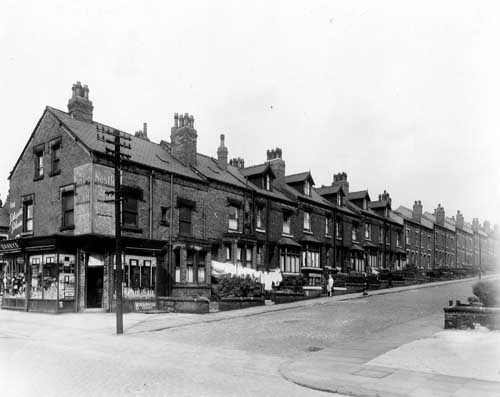
The houses built in this late period were not the cramped courts of the early 19th century. They represented the mature form of the back-to-back:
- Wide streets allowing light and air to reach ground floors
- Forecourts providing privacy from the pavement
- Sculleries separating washing from cooking
They were robust, affordable, and well-built — effectively a starter home for working families decades before the term existed. [7]
From Rubble to Recreation: The Story of Banstead Park
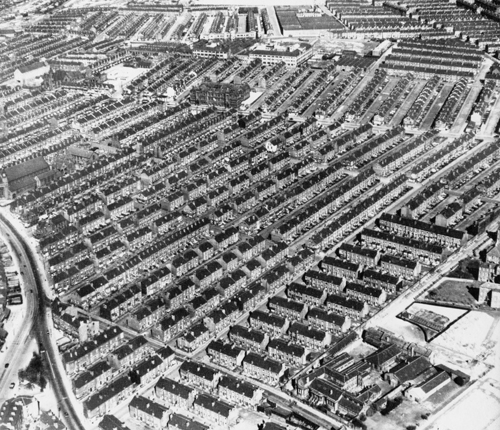
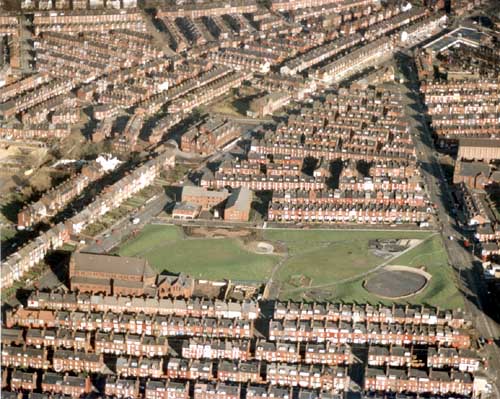
Not all housing survived. In the late 1970s, parts of Banstead Grove and Harehills Terrace were cleared after being declared unfit for habitation. [9]
Unlike the sweeping slum clearances of the 1950s, this was a targeted intervention. In 1983, the cleared land was transformed into Banstead Park, funded by a £186,000 Urban Programme grant. What had been streets of dereliction became a shared green space — a rare commodity in dense inner Leeds. [9]
Source: Harehills local history.
The Bathroom Revolution
Until the late 1960s, many houses still relied on outside toilets. The Housing Act 1969 changed this by funding improvements through General Improvement Areas.
Across Harehills, internal bathrooms were installed, often by adapting box rooms or attic spaces. This wave of modernisation made the back-to-back fit for contemporary life — and ensured its survival. [8]
The Modern View: From Liability to Carbon Asset
Today, back-to-backs are being reassessed in the context of the climate emergency.
Research into embodied carbon shows that the energy used to build these houses over a century ago is a sunk environmental cost. Demolishing them and rebuilding with concrete and steel can result in higher total emissions for decades compared to retrofitting existing structures. [10]
Studies by the University of Leeds, TU Delft, and the Leeds Sustainability Institute at Leeds Beckett University have helped shift policy away from “demolish and rebuild” toward retain and retrofit — particularly for solid-walled Victorian housing. [10]
Harehills’ high density — comparable to what many modern eco-developments now seek — supports walkability, public transport, and local shops, reducing car dependency. [11]
Timeline: Two Centuries of Resilience
- 1825 – The “New Leeds” speculation: Land east of Leeds, including what would become Harehills and Chapeltown, is sold off by Earl Cowper. Early maps and deeds show ambitions for a planned suburban extension of the city, later referred to as “New Leeds”, aimed at attracting wealthier residents away from the overcrowded centre. Development proves slow and fragmented, and the scheme never materialises as intended. – Sources: Chapeltown & Potternewton histories; Changing Landscapes (pp. 4–8). [1][2][3]
- 1890s – The red-brick rise: Large-scale housebuilding begins in Harehills. Developers construct improved back-to-back houses, with wider streets, better sanitation, and planned layouts — a marked improvement on earlier inner-city courts.
- 1909 – The great ban (and the loophole): The Housing and Town Planning Act 1909 effectively bans new back-to-back houses in England and Wales. Leeds Corporation successfully continues building under a provision allowing previously approved schemes to proceed. [5][6]
- 1937 – The last bricks laid: The final back-to-back houses in Leeds are completed — almost 30 years after the national ban. At its peak, back-to-backs make up a very large proportion of Leeds’ housing stock, far more than in any other British city. [4][6]
- 1969 – The bathroom revolution: The Housing Act 1969 introduces grants for “standard amenities.” Across Harehills, outside toilets are replaced with indoor bathrooms, often by adapting box rooms or attics — a turning point that saves many houses from demolition. [8]
- 1979 – The Banstead Grove inquiry: A public inquiry confirms clearance of the Banstead Grove area, where housing is deemed unfit for habitation, despite local opposition. [9]
- 1983 – Green space from rubble: Leeds City Council secures £186,000 in Urban Programme funding to landscape the cleared site. Work begins on Banstead Park, creating a rare green space within the dense inner-city grid. [9]
- 2020s – The carbon asset: New research reframes Victorian terraces as a climate asset rather than a liability. Attention shifts from demolition to retrofitting and retention. [10][11]
Back to the Future: The 21st-Century Revival
In a final twist of irony, architects are now rediscovering the virtues of the back-to-back.
Sharing walls on three sides dramatically reduces heat loss. Dense, street-focused housing is once again seen as socially and environmentally sustainable.
Examples include:
- Peter Barber’s “Tower Houses” in Stratford — modern back-to-backs with roof terraces
- Quad or cluster homes quietly re-introduced by volume builders
- Leeds’ Climate Innovation District, where dense terraces use modern ventilation and timber construction to solve the Victorian problems of damp and air quality
The lesson is clear. The builders of Harehills were right about density and shared living. They simply lacked modern plumbing and insulation.
Today, the humble back-to-back is no longer a relic.
It may be a blueprint for the future. [12]
Living History – A Call to Action
Does your house have a story to tell? We’d love to see photos of your original Victorian features, 1930s sculleries, or even those creative bathroom conversions! Share your photos and memories in the comments below, or email us at [your email] to help us document the living history of Harehills.
End Notes & Sources
1. Early land ownership and “New Leeds” speculation
Much of the land covering modern Harehills, Chapeltown and Potternewton was owned by Earl Cowper and sold for development from 1825 onwards. Contemporary maps and later historical accounts describe ambitions for a planned suburban extension of Leeds, later referred to as “New Leeds”.
Sources:
– Chapeltown, Leeds (Wikipedia)
– Potternewton (Wikipedia)
– Changing Landscapes: Harehills and Chapeltown (Leeds City Council / TLANG, pp. 4–8)
2. Rural character prior to development
Early 19th-century mapping shows Harehills as open farmland on the northern edge of Leeds, with only scattered buildings prior to large-scale housebuilding in the late Victorian period.
Source:
– Changing Landscapes: Harehills and Chapeltown
3. Slow and fragmented early development
Although land was sold from the 1820s, development progressed slowly due to economic instability and limited transport connections. Large-scale residential building did not take place until later in the 19th century.
Sources:
– Chapeltown, Leeds (Wikipedia)
– Harehills local history summaries
4. Back-to-back housing in Leeds
Leeds developed more back-to-back housing than any other British city, and a very large proportion of its late-19th and early-20th-century housing stock was of this type.
Sources:
– A Short History of Back-to-Back Houses in Leeds (1890–1937)
– HarehillsLove, The Back-to-Backs of Harehills and Chapeltown (2020)
5. Housing and Town Planning Act 1909
The 1909 Act effectively banned the construction of new back-to-back houses in England and Wales, introducing modern housing standards focused on light, ventilation and sanitation.
Source:
– Housing, Town Planning, etc. Act 1909 (Wikipedia)
6. Leeds’ use of “approved scheme” exemptions
Leeds continued building back-to-back houses after 1909 by completing schemes that had already received approval before the Act came into force. Construction continued until 1937.
Sources:
– Back-to-Back Houses in Leeds research
– Leeds housing history publications
7. Improved back-to-backs and later design standards
Later back-to-back houses in areas such as Harehills featured wider streets, better drainage, sculleries and improved internal layouts compared to early 19th-century courts.
Sources:
– Back-to-Back Houses in Leeds (1890–1937)
– HarehillsLove (2020)
8. Housing Act 1969 and home improvements
The Housing Act 1969 introduced grants and improvement programmes that enabled the installation of indoor bathrooms, modern kitchens and other standard amenities in older housing.
Source:
– Housing Act 1969 (Wikipedia)
9. Banstead Grove clearance and Banstead Park
Parts of Banstead Grove and surrounding streets were cleared following a public inquiry in the late 1970s. In 1983, Urban Programme funding was used to create Banstead Park on the cleared land.
Sources:
– HarehillsLove local history articles
– Leeds City Council regeneration records
10. Embodied carbon and retrofit research
Research by the University of Leeds, TU Delft and the Leeds Sustainability Institute at Leeds Beckett University highlights the importance of embodied carbon and the environmental benefits of retaining and retrofitting existing housing rather than demolishing and rebuilding.
Sources:
– Leeds Sustainability Institute (Leeds Beckett University)
– University of Leeds sustainability research
– Leeds City Council climate and housing policy documents
11. Density, walkability and sustainable urban form
Victorian terraces in areas such as Harehills achieve residential densities comparable to those now promoted in modern sustainable urban design, supporting walkability, local services and public transport use.
Sources:
– Leeds City Council planning policy documents
– Urban density research referenced in Leeds climate strategies
12. Contemporary revival of dense housing forms
Modern architectural projects — including Peter Barber’s housing in London and Leeds’ Climate Innovation District — reflect renewed interest in dense, terrace-based housing forms with modern ventilation and energy standards.
Sources:
– Peter Barber Architects
– Citu / Climate Innovation District (Leeds)
Sources & methodology note
This article draws on published research, local history sources, and long-standing community knowledge. Where precise figures vary between sources, we have prioritised well-established consensus rather than absolute numbers.
 Harehills ❤️ Love
Leave a comment